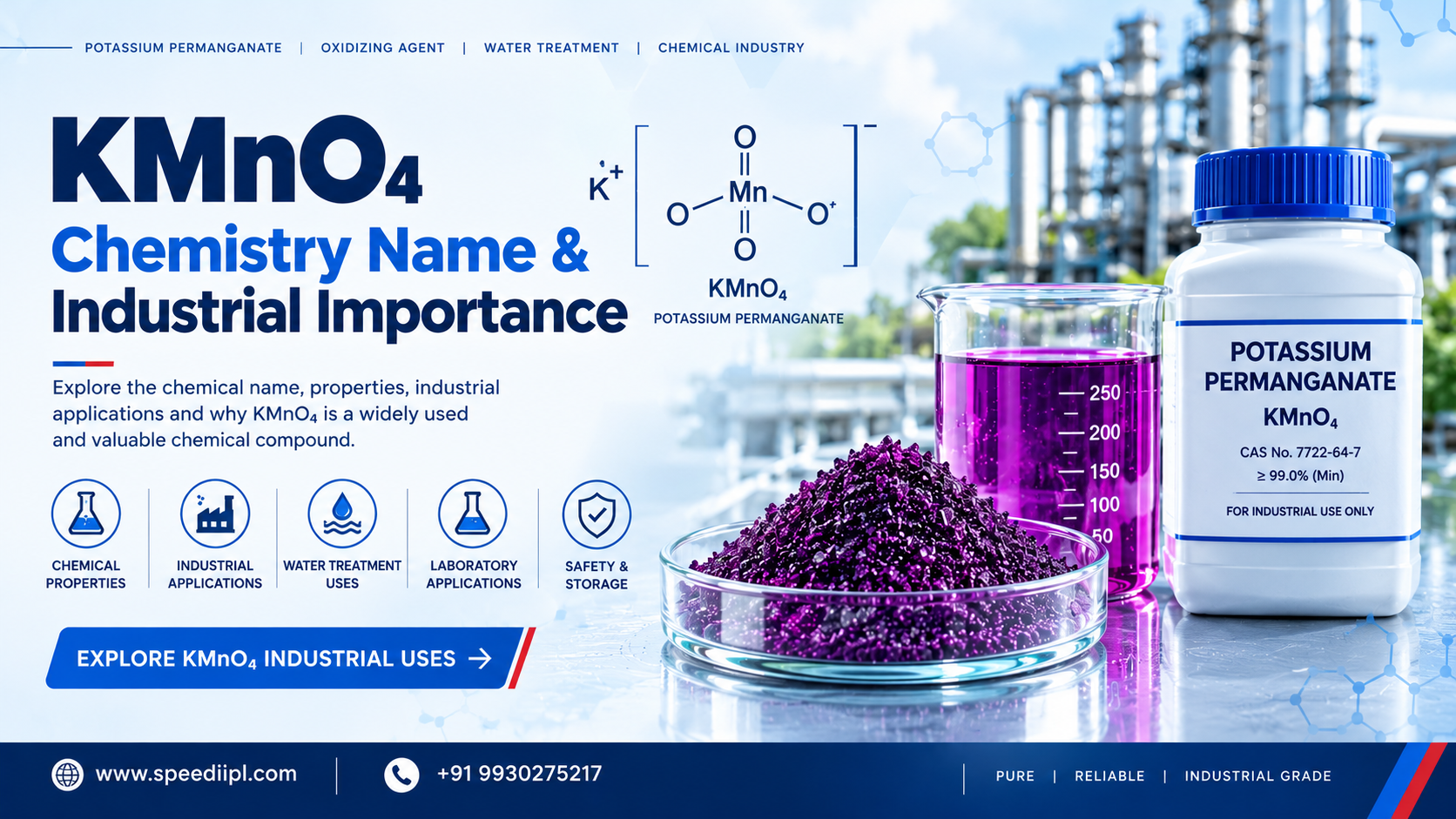
KMnO₄ is an important chemical compound widely used in water treatment, chemical manufacturing, laboratory processes, and various industrial applications. Understanding the KMnO4 chemistry name helps explain its properties, reactions, and importance across different industries.
The chemical name of KMnO₄ is potassium permanganate. It is a powerful oxidizing agent recognized by its deep purple color and ability to participate in oxidation-reduction reactions. Depending on the application, potassium permanganate can be used for contaminant control, chemical analysis, treatment processes, and specialized industrial operations.
For businesses involved in water treatment, chemical processing, and industrial manufacturing, understanding potassium permanganate uses, handling requirements, and product specifications is essential.
In this guide, we explain the KMnO4 chemical name, chemical properties, industrial applications, water treatment uses, laboratory reactions, safety guidelines, and important sourcing considerations.
What Is the KMnO4 Chemistry Name?
The KMnO₄ chemistry name is potassium permanganate. It is an inorganic chemical compound made up of potassium, manganese, and oxygen.
Its chemical formula is KMnO₄, and it consists of potassium ions and permanganate ions. Manganese is present in the +7 oxidation state, which contributes to the compound’s strong oxidizing properties.
Potassium permanganate is generally available as dark purple or nearly black crystals that produce a purple-colored solution when dissolved in water.
Full Chemical Name and Formula Explained
The chemical formula KMnO₄ represents the elements present in the compound:
- K: Potassium
- Mn: Manganese
- O₄: Four oxygen atoms
The compound is commonly known as potassium permanganate, while KMnO₄ is its chemical formula.
Potassium permanganate is widely used because it can oxidize a range of inorganic and organic substances under suitable conditions. Its exact reaction depends on factors such as pH, concentration, temperature, and the substance being treated.
Why Is Potassium Permanganate Important?
Potassium permanganate has several valuable chemical characteristics that make it useful in different sectors.
Its importance is associated with:
- Strong oxidizing capability
- Distinctive purple color
- Use in oxidation-reduction reactions
- Applications in selected water treatment processes
- Use in laboratory analysis
- Applications in chemical manufacturing
These properties make potassium permanganate an important chemical for industrial users who require controlled oxidation processes.
Chemical Properties of KMnO₄
Understanding the chemical properties of potassium permanganate helps explain why it is used in industrial and laboratory applications.
Some of its key characteristics include:
- Chemical formula: KMnO₄
- Chemical name: Potassium permanganate
- Appearance: Dark purple or nearly black crystalline solid
- Solubility: Soluble in water, producing a purple solution
- Chemical behavior: Strong oxidizing agent
- Manganese oxidation state: +7
The compound’s behavior varies depending on the reaction environment and the substances with which it comes into contact.
Oxidizing Properties of KMnO₄
Potassium permanganate is widely recognized for its oxidizing properties. In oxidation-reduction reactions, permanganate can accept electrons from other substances, causing those substances to undergo oxidation.
The products formed depend on the reaction conditions. For example, manganese may form different products under acidic, neutral, or alkaline conditions.
This ability makes potassium permanganate useful in chemical analysis, selected contaminant-removal processes, and industrial treatment applications.
Physical and Chemical Characteristics
Potassium permanganate’s dark purple crystals and intense purple aqueous solutions make it relatively easy to recognize.
However, appearance alone is not sufficient to determine product purity or suitability. Industrial buyers should review the applicable product specifications, assay, impurity limits, and Certificate of Analysis before selecting a material for a particular process.
Because potassium permanganate is a strong oxidizer, it must also be stored and handled carefully.
Industrial Uses of Potassium Permanganate
Potassium permanganate uses extend across several industrial sectors. Its role depends on the required oxidation process, operating conditions, and product specification.
Common application areas include:
- Water treatment
- Chemical manufacturing
- Laboratory analysis
- Selected industrial wastewater treatment processes
- Odor and contaminant control
- Specialized chemical processing
Applications in Industrial Manufacturing
In industrial processes, potassium permanganate may be used as an oxidizing agent to support specific chemical transformations.
Its applications can include oxidation steps, selected chemical treatment operations, and analytical procedures.
Before using KMnO₄ in a manufacturing process, businesses should evaluate reaction compatibility, dosage requirements, operating conditions, and potential by-products.
The chemical should only be used where its properties and handling requirements are appropriate for the intended process.
Potassium Permanganate for Disinfection
Potassium permanganate has historically been used in certain water treatment and other specialized treatment applications because of its oxidizing action.
However, it should not be treated as a universal disinfectant. The suitability of KMnO₄ for a disinfection application depends on the intended use, applicable regulations, validated treatment procedure, and required microbial performance.
For drinking water, treatment must follow approved methods and appropriate testing. Potassium permanganate does not automatically make unsafe water potable, and it should not be dosed into drinking water without a properly designed and controlled treatment process.
KMnO₄ in Water Treatment Applications
One important application of potassium permanganate is water treatment. Under appropriate conditions, it can oxidize certain dissolved substances that affect water quality.
These may include dissolved iron, manganese, and selected compounds responsible for undesirable odors.
Removal of Contaminants from Water
In suitable treatment systems, potassium permanganate can oxidize dissolved iron and manganese into forms that can subsequently be removed through processes such as filtration.
The effectiveness of treatment depends on several factors:
- Initial water quality
- Concentration of iron and manganese
- Water pH and temperature
- Chemical dose and contact time
- Filtration system performance
- Presence of other oxidizable substances
The correct dosage should be determined through water testing, process design, and professional evaluation rather than a general-purpose dosing recommendation.
Excess potassium permanganate can leave residual pink or purple coloration and may affect water quality. Treatment systems should therefore include suitable control and monitoring procedures.
Potassium Permanganate in Water Reaction
When potassium permanganate dissolves in water, it forms a purple solution containing potassium and permanganate ions.
Its subsequent chemical reactions depend on the substances present and the pH of the water.
For example, in an appropriately designed iron-removal process, permanganate oxidizes dissolved ferrous iron into ferric forms that can precipitate and be filtered out.
A simplified representation of the oxidation of ferrous iron is:
MnO₄⁻ + Fe²⁺ → manganese and iron reaction products
This is a conceptual representation rather than a balanced chemical equation. Actual reaction products and stoichiometry depend on the water chemistry and reaction conditions.
In practical applications, potassium permanganate is commonly used as part of a treatment system rather than as a complete stand-alone purification method.
KMnO₄ in Chemical Reactions and Laboratories
Potassium permanganate is an important reagent in chemistry laboratories because of its oxidizing properties and distinctive color.
It is commonly used in selected analytical procedures and oxidation-reduction experiments.
Oxidation Reactions in Laboratories
In analytical chemistry, potassium permanganate can be used in redox titrations to determine the concentration of certain reducing agents.
Under acidic conditions, permanganate ions are commonly reduced to manganese ions in a reaction that produces a measurable endpoint.
The strong purple color of permanganate makes it useful in certain titrations, where a persistent faint pink color can indicate the endpoint when the method is appropriately performed.
The exact procedure depends on the analyte, reaction conditions, and validated analytical method.
Common Chemical Experiments Using KMnO₄
Laboratory applications may include:
- Oxidation-reduction titrations
- Studies of redox reactions
- Demonstrations of oxidation chemistry
- Selected quantitative chemical analyses
- Evaluation of reaction behavior under controlled conditions
Experiments should be conducted by trained personnel using suitable laboratory equipment and safety procedures. Potassium permanganate must not be mixed casually with incompatible substances.
Safety and Storage Guidelines
Potassium permanganate is a strong oxidizing agent. Appropriate precautions are essential during storage, transport, weighing, and use.
Safe Handling and Transportation Methods
General safety practices include:
- Read the current Safety Data Sheet (SDS) before use.
- Wear suitable protective gloves, safety goggles, and protective clothing.
- Avoid contact with skin and eyes.
- Prevent the formation and inhalation of dust.
- Use appropriate ventilation and handling equipment.
- Keep the product away from combustible and incompatible materials.
- Follow applicable chemical transport and labeling requirements.
Potassium permanganate can intensify fires when it comes into contact with combustible materials. It should not be mixed with incompatible chemicals, organic materials, or reducing agents outside a properly assessed and controlled process.
Proper Industrial Storage Practices
To preserve product quality and reduce hazards:
- Store in a tightly closed, compatible container.
- Keep the material in a cool, dry, well-ventilated location as directed by the SDS.
- Protect it from contamination and moisture.
- Segregate it from combustible materials and incompatible chemicals.
- Maintain clear labeling and batch identification.
- Follow the supplier’s storage and shelf-life recommendations.
Storage facilities should be suitable for oxidizing chemicals, with appropriate emergency procedures and access controls.
Environmental Impact and Precautions
Potassium permanganate can affect aquatic organisms and environmental chemistry if released in inappropriate quantities. Its reaction products and environmental behavior depend on the receiving environment and the substances present.
Environmental Safety Considerations
Businesses using KMnO₄ should consider:
- Preventing accidental spills and uncontrolled releases
- Avoiding discharge without appropriate evaluation and treatment
- Following local environmental and wastewater regulations
- Using suitable containment and spill-response procedures
- Disposing of waste according to applicable requirements
Spills should be handled by trained personnel following the SDS and site-specific procedures. Do not use combustible absorbents or improvised cleanup methods that could react dangerously with this oxidizer.
Preventing Accidental Chemical Reactions
Potassium permanganate should be segregated from incompatible materials during storage and handling.
Risk assessments should consider the chemicals present, operating temperatures, concentration, possible contamination, and the consequences of unintended reactions.
Industrial users should maintain written procedures, provide appropriate training, and ensure that employees understand the risks associated with oxidizing agents.
Frequently Asked Questions About KMnO₄
What is the KMnO4 chemistry name?
The KMnO₄ chemistry name is potassium permanganate. It is an inorganic compound commonly used as an oxidizing agent in selected industrial, water treatment, and laboratory applications.
What is KMnO₄ used for?
KMnO₄ is used in certain water treatment systems, redox titrations, chemical manufacturing processes, and other applications that require controlled oxidation.
What are the main potassium permanganate uses in water treatment?
Potassium permanganate can help oxidize dissolved iron and manganese and selected odor-causing compounds under appropriate conditions. Filtration or additional treatment may be required to remove reaction products.
What happens when potassium permanganate is added to water?
Potassium permanganate dissolves to form a purple solution. Its subsequent reactions depend on the water’s pH, composition, concentration, and other treatment conditions.
Why is manganese important in KMnO₄?
Manganese is part of the permanganate ion and is present in the +7 oxidation state. Its ability to undergo reduction is central to potassium permanganate’s oxidizing behavior.
Is potassium permanganate safe for drinking water?
Potassium permanganate is used in certain professionally controlled water treatment systems, but it should not be added to drinking water without a validated treatment design and appropriate monitoring. It does not by itself guarantee that water is safe to drink.
How should potassium permanganate be stored?
Store it in a suitable, labeled, tightly closed container under the conditions specified in the SDS. Keep it segregated from combustible materials and incompatible chemicals.
What should buyers check when sourcing potassium permanganate?
Buyers should review the required grade, assay, product specification, Certificate of Analysis, SDS, packaging, batch traceability, and supplier reliability.
Looking for a Reliable Potassium Permanganate Supplier in India?
Choosing the right chemical supplier is important for consistent product quality, safe handling, and dependable procurement. Whether your requirement involves water treatment, laboratory analysis, or an industrial oxidation process, verify that the product grade and specifications match your intended application.
When evaluating potassium permanganate manufacturers and distributors in India, consider product documentation, batch consistency, packaging, storage practices, and supply reliability.
Contact Speed International for Your Chemical Sourcing Requirements
Looking for potassium permanganate for an industrial, laboratory, or water treatment application?
Contact Speed International to discuss your required grade, quantity, packaging, product specifications, and relevant quality documentation. Share your intended application so the appropriate product requirements can be identified.
Request a Quote for Potassium Permanganate
Visit Speed International to enquire about chemical supply and discuss your procurement requirements with the team.
Choose your chemical supplier based on verified specifications, appropriate documentation, and safe handling requirements—not price alone.
Important: Potassium permanganate is a strong oxidizer. Its use, storage, and transport must comply with the applicable safety documentation and regulations.